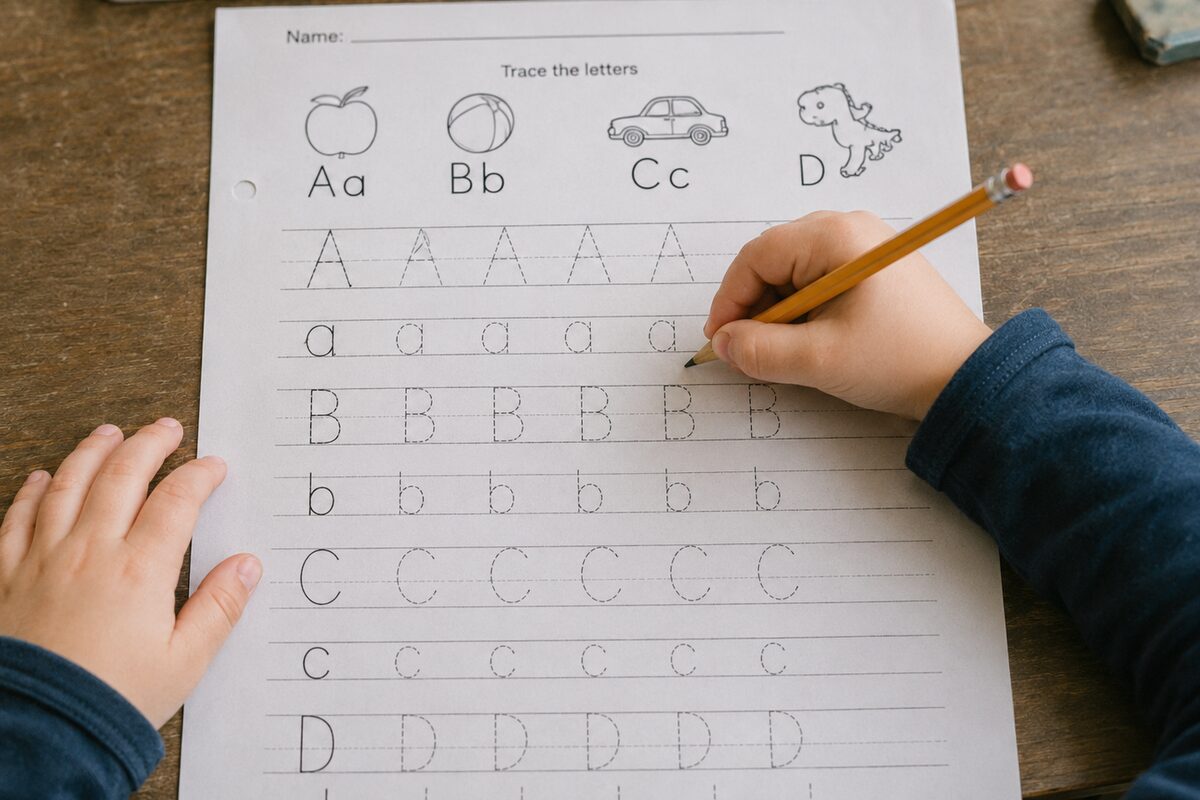
Your four-year-old picks up your phone and, within seconds, is swiping through a learning app: tapping answers, collecting gold stars, watching a cartoon fox cheer them on. It looks like learning. Then you sit the same child down with a pencil and a simple worksheet, and something shifts. They squirm. They guess instead of reading the question. When you ask, "How did you get that answer?" they shrug.
That small moment raises a question a lot of parents are quietly asking: do learning apps actually teach kids to think, or just to react quickly? This isn't an argument against technology. iPads, Chromebooks, and good apps all have a place. But there's a strong case, backed by decades of learning research, that in the early years slow, hands-on, effortful practice should come first, and screens second. Here's why, and how to make it work at home.
Engagement is not the same as learning
Most children's apps are designed to be irresistible, and they're very good at it. Points, badges, streaks, celebratory sounds, instant rewards: none of that is an accident. Those features solve the engagement problem brilliantly.
The trouble is that engagement and learning aren't the same thing. A child can light up, finish twenty levels, and still be unable to explain what they learned. The app kept them busy and happy. It didn't necessarily make them think. There's a subtler cost, too. Once a brain gets used to bright feedback every few seconds, a quiet worksheet can start to feel flat. The fix isn't to make worksheets flashier — it's to help children rediscover the satisfaction of figuring something out for themselves.
What the brain actually learns from
You've probably heard dopamine called the "pleasure chemical." That's a myth worth correcting, because it sends parents in the wrong direction.
In neuroscience, dopamine is less about pleasure and more about motivation and learning. Work by the neuroscientist Wolfram Schultz and colleagues in the 1990s showed that dopamine signals track reward prediction error: the gap between what the brain expected and what actually happened (Schultz, Dayan & Montague, 1997). When a reward is bigger or sooner than expected, dopamine spikes; when it disappoints, it dips. The brain uses that gap as a teaching signal. In other words, we learn from surprise: from trying, being a little wrong, and adjusting.
This is where the science and the marketing part ways. App-style streaks and badges are good at getting a child to show up. But the signal that supports learning comes from making a real attempt, finding out whether it was right, and correcting course. A badge for tapping the screen doesn't reliably produce that. (None of this means screens "damage" the brain. It just means a motivational nudge doesn't create understanding on its own.)
The same logic explains why too much instant feedback can backfire. When an app tells a child immediately whether each tap is right, some children stop thinking and start guessing. Guessing is faster, and the app will sort it out. Paper creates a natural pause between question and answer, and in that small gap, real thinking happens.
Why humble worksheets still matter
A worksheet looks old-fashioned next to a glowing tablet, but it creates a fundamentally different environment: fewer animations, fewer shortcuts, less instant guessing, more deliberate effort. A good one asks a child to do several things at once — look, read, hold the instruction in mind, write, count, check, and correct. Along the way they build fine motor control, learn to follow directions, and develop the patience to sit with something that isn't instantly easy. Psychologists call that tolerating productive struggle, and it's one of the quiet engines of real learning.
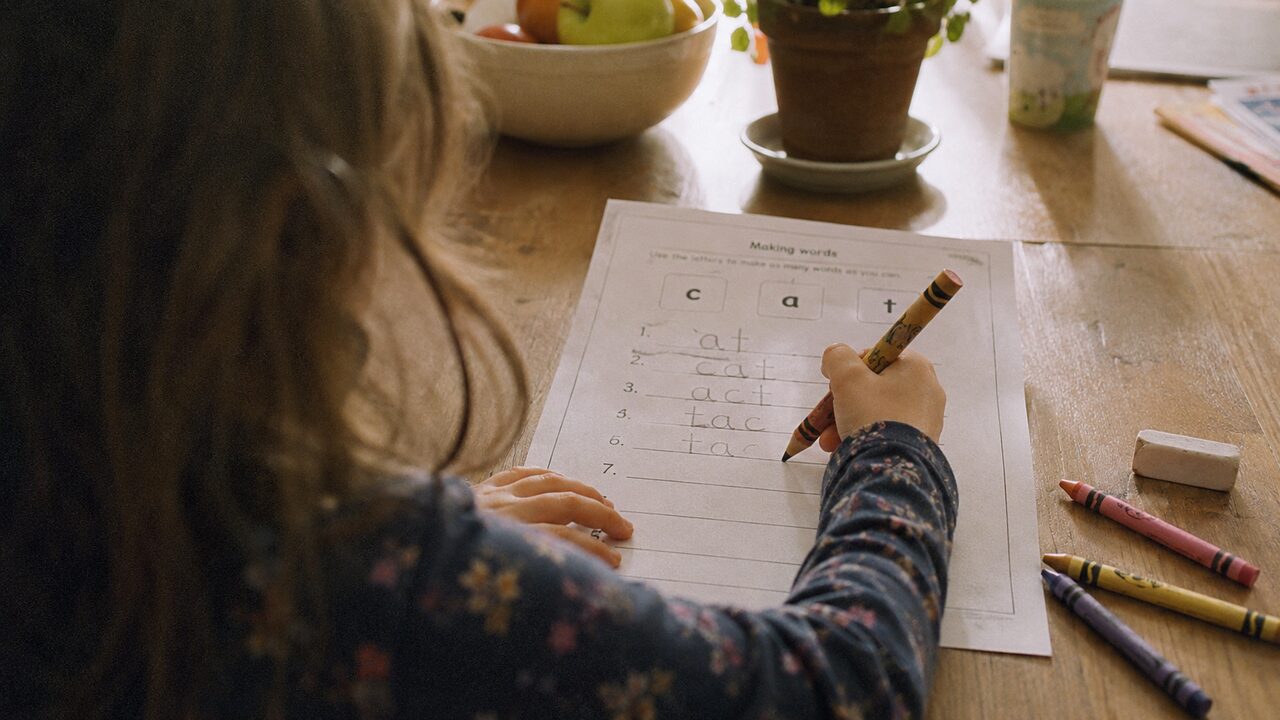 Thinking made visible: every attempt, right or wrong, stays on the page.
Paper has one more advantage parents love: it makes thinking visible. You can see exactly where your child sailed through and where they got stuck, which is far harder to spot when the answer vanishes behind a tap. And children remember more when they act on information than when they watch it go by. Tracing a letter, circling the odd one out, matching numbers to objects, finding the mistake: all of it pushes the brain to organize and process. That's the difference between a participant and a spectator.
The methods that genuinely work
In a widely cited 2013 review, psychologist John Dunlosky and colleagues compared ten common study strategies and found two stood out above the rest: practice testing and spaced practice (Dunlosky et al., 2013). These are techniques, not formats; an app can be built around them too. But paper happens to be a natural fit for all of them, and it makes them easy to run at home. Here's the parent-friendly version.
- Retrieval practice (active recall): Children learn more by trying to pull an answer out of memory than by rereading or rewatching. The effort of remembering is what strengthens it — in a classic experiment, Roediger and Karpicke (2006) showed that being tested on material beat restudying it. A worksheet that asks a child to produce an answer is retrieval practice in disguise.
- Spaced repetition: A little practice across several days beats one long cram. Revisit a concept after a few days, then again later.
- Interleaving: Mixing problem types, instead of twenty of the same, helps a child learn when to use a skill, not just how to repeat it.
- Elaboration: Ask "Why?" and "How do you know?" Putting reasoning into words deepens understanding.
- Desirable difficulty: Psychologist Robert Bjork's term for a useful truth: learning that feels a little hard often sticks better than learning that feels easy.
It's worth noticing what the strongest early-education programs do. Montessori and play-based preschools lean hard on exactly this kind of hands-on, self-correcting work, and use surprisingly little screen time to do it.
Video vs. app vs. paper, side by side
| Passive video | Tapping app | Pencil & paper | |
|---|---|---|---|
| What the child does | Watches | Taps, often guesses | Reads, thinks, writes, recalls, checks |
| Feedback | None | Instant, every tap | Delayed — a pause to think |
| What it builds | Familiarity (feels like learning) | Engagement | Memory, focus, self-correction |
| Thinking visible? | No | No | Yes — you see where they got stuck |
The richest learning happens when a child predicts, attempts, gets feedback, corrects, and tries again: the same prediction-and-correction loop the dopamine research describes. Paper invites that loop naturally. It also explains a common scene at home. A child nods along to a video, then freezes on the worksheet. Recognizing something is far easier than recalling it, and familiarity is not the same as memory.
How to use worksheets well at home
- Keep sessions short — roughly 10–20 minutes, depending on age.
- Treat a worksheet as practice, never punishment.
- Ask your child to explain one or two answers out loud.
- Mix old and new topics in the same sitting, and revisit a concept a few days later.
- Let mistakes stay visible, and correct them together, calmly.
- For younger kids, bring in crayons, stickers, cutting, and sorting.
- Praise effort, strategy, and self-correction, not just right answers.
A fair word for iPads and Chromebooks
Screens are genuinely useful — for demonstrations, audio, accessibility, extra practice, and variety — and for some children they open doors paper can't. The point isn't to ban them; it's to order them well. A good rule of thumb: let your child try on paper first, then use a screen to extend the learning. When you do go digital, prefer tools that ask a child to think, explain, recall, and create, not just tap for a reward. The most useful screen, oddly, might be the one that just prints good practice and then gets out of the way.
What this looks like by age
| Ages 2–5 | Ages 5–7 | Ages 7–8 |
|---|---|---|
| Tracing lines and letters | Phonics and sight-word recall | Word problems, mixed math |
| Matching and sorting | Simple addition and subtraction | Reading comprehension |
| Counting and coloring by instruction | Number lines | "Explain your answer" questions |
| Picture sequencing | Story sequencing, shape patterns | Short memory-review sheets |
The bottom line
Children don't need more stimulation to learn better. They need more chances to think, recall, write, explain, struggle a little, fix their mistakes, and try again. Worksheets aren't a replacement for good teaching or a warm, curious home, but they're one of the simplest, most reliable tools for building attention, memory, and independent learning. Start with paper. Let the screen come second.
There's a neat irony in all this: the easiest way to get good paper practice in front of your child is a screen. Kay5 is a worksheet generator. You choose the skill, the age, and the level, and it makes a clean, printable sheet built for exactly the kind of slow, thinking-visible practice described here. The app does the prep; your child does the work on paper. Generate a worksheet for the skill your child is working on this week.
Frequently asked questions
Are iPads and Chromebooks bad for kids?
No. They're useful for demonstrations, audio, accessibility, and practice. The concern is relying on them too early or too heavily, before a child has built strong habits of reading, writing, recalling, and explaining. Treat screens as a way to extend learning, not the foundation of it.
Are worksheets better than apps?
For core early skills, well-designed worksheets have real advantages: they slow children down, reduce guessing, and make thinking visible. Apps are great for engagement and variety, and a well-built app can teach too. The best approach uses both — paper first, screens second.
How long should my child do worksheets daily?
Around 10–20 minutes a day is plenty for most young children. Short and consistent beats long and occasional.
What if my child finds worksheets boring?
Common, especially for kids used to fast app feedback. Keep sessions short, mix topics, add crayons or stickers, and turn answers into a conversation ("How did you figure that out?").
What's the best way to improve memory in kids?
Active recall: have your child try to remember an answer rather than reread or rewatch, then space that practice across the week. Worksheets make both easy at home.
References
- Schultz, W., Dayan, P., & Montague, P. R. (1997). A neural substrate of prediction and reward. Science, 275(5306), 1593–1599. doi:10.1126/science.275.5306.1593
- Dunlosky, J., Rawson, K. A., Marsh, E. J., Nathan, M. J., & Willingham, D. T. (2013). Improving students' learning with effective learning techniques. Psychological Science in the Public Interest, 14(1), 4–58. doi:10.1177/1529100612453266
- Roediger, H. L., & Karpicke, J. D. (2006). Test-enhanced learning: Taking memory tests improves long-term retention. Psychological Science, 17(3), 249–255. doi:10.1111/j.1467-9280.2006.01693.x